P1=lyap(A1',Q1);
A2=[1 4 0;-3 -2 -3;2 0 0];Q2=eye(length(A2));
P2=dlyap(A2',Q2);
9-41 试列写如图9-14所示电网络中以电流\(i(t)\)为输入,电容\(C_1\)、\(C_2\)上的端电压\(v_{C_1}\)、\(v_{C_2}\)为输出的动态方程。
解 由于
\[
\begin{cases}
i(t) = i_3(t) + C_2\dfrac{\mathrm{d}v_{C_2}(t)}{\mathrm{d}t} + i_2(t) \\[2mm]
i_2(t) = C_1\dfrac{\mathrm{d}v_{C_1}(t)}{\mathrm{d}t} + i_1(t) \\[2mm]
L_1\dfrac{\mathrm{d}i_1(t)}{\mathrm{d}t} = v_{C_1}(t) \\[2mm]
L_2\dfrac{\mathrm{d}i_2(t)}{\mathrm{d}t} = v_{C_2}(t) - v_{C_1}(t) \\[2mm]
L_3\dfrac{\mathrm{d}i_3(t)}{\mathrm{d}t} = v_{C_2}(t)
\end{cases}
\]
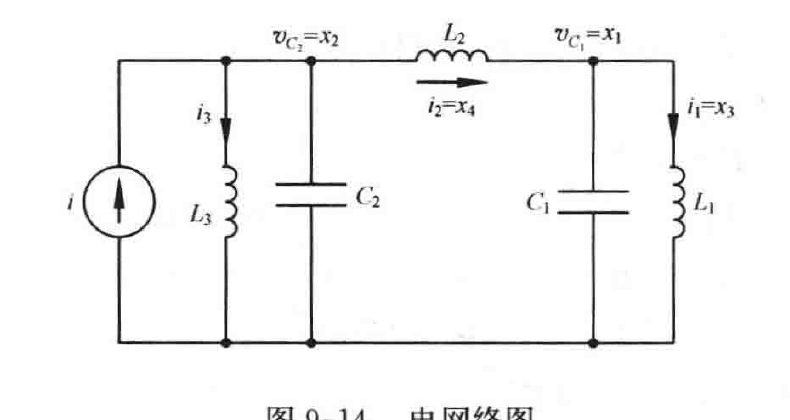
当分别取\(x_1=v_{C_1}\),\(x_2=v_{C_2}\),\(x_3=i_1\),\(x_4=i_2\),\(x_5=i_3\),\(i=u\),\(y_1=v_{C_1}\),\(y_2=v_{C_2}\)时,动态方程的状态和输出表达式为
\[
\dot{\boldsymbol{x}} =
\begin{bmatrix}
0 & 0 & -\dfrac{1}{C_1} & \dfrac{1}{C_1} & 0 \\[2mm]
0 & 0 & 0 & -\dfrac{1}{C_2} & -\dfrac{1}{C_2} \\[2mm]
\dfrac{1}{L_1} & 0 & 0 & 0 & 0 \\[2mm]
-\dfrac{1}{L_2} & \dfrac{1}{L_2} & 0 & 0 & 0 \\[2mm]
0 & \dfrac{1}{L_3} & 0 & 0 & 0
\end{bmatrix}
\boldsymbol{x}
+
\begin{bmatrix}
0 \\
\dfrac{1}{C_2} \\
0 \\
0 \\
0
\end{bmatrix}
u,
\qquad
\boldsymbol{y} =
\begin{bmatrix}
1 & 0 & 0 & 0 & 0 \\
0 & 1 & 0 & 0 & 0
\end{bmatrix}
\boldsymbol{x}
\]
9-42 设有系数矩阵\(\boldsymbol{A}\in R^{m\times n}\),未知数为\(x_1,x_2,\cdots,x_n\)的线性方程组\(\boldsymbol{Ax}=0\)。试证明:若\(\mathrm{rank}\boldsymbol{A}=r\),则具有\(n-r\)个线性独立解,且方程式的任何解都可以用其线性组合来表示。
证明 设齐次线性方程组的系数矩阵
\[
\boldsymbol{A} =
\begin{bmatrix}
a_{11} & a_{12} & \cdots & a_{1n} \\
a_{21} & a_{22} & \cdots & a_{2n} \\
\vdots & \vdots & & \vdots \\
a_{m1} & a_{m2} & \cdots & a_{mn}
\end{bmatrix}
\]
根据高斯消元法,将矩阵\(\boldsymbol{A}\)化为阶梯形矩阵
·526·